
Searching Pike County Criminal Dockets
For a Superior Court matter, begin with the Pike County Clerk of Superior Court. Its "Search Civil and Criminal Cases" link opens an Icon Case Management login. There is no free guest query there. There are no public fields for name, number, status, or date. Treat an account-gated filing system as closed, not as an open index.
A sound search uses every channel the official sources list. Keep the court name, case number, and any known setting date close at hand. The online route can stall. Then call the Clerk's criminal staff or visit the records counter. Work from the posted calendar instead.
- Identify the issuing or filing court.
- Check the latest official calendar.
- Try the provider portal if authorized.
- Call or visit the correct clerk when a scan is unclear.
- Request the named pleading, order, or certified copy when needed.
Pike Criminal Calendars Need Care
Pike County posts Criminal, Criminal Calendar Call, and Criminal Jury Trial calendars as PDFs. The current files are scanned images rather than text. They prove a calendar went up. They do not support a reliable list of every field or code, and a faint line on a scan is never proof that an event is missing.
Compare the newest calendar with any notice already received. Write down the Pike County criminal case number and date, then call criminal staff. A later PDF can amend an earlier list. And never copy civil-calendar codes onto a criminal docket entry; they do not mean the same thing.
Practical point: A posted scan is a setting source, not a full Pike County criminal docket history. Confirm uncertain dates with the court.
Inside a Pike County Criminal Docket
A Pike County criminal docket can carry a case identifier, the court, role labels, charging events, filed dates, bond or appearance events, settings, pleas, disposition, sentence or order events, appeals, and document indicators. The portal offers no complete public vocabulary for these entries. This list follows the official Criminal Division scope without inventing labels.
| Case number | The court's unique identifier; no public Pike criminal pattern was confirmed. |
|---|---|
| Charging event | An accusation, indictment, or warrant filed in the case. |
| Calendar setting | A call, pretrial, jury, or other date. |
| Disposition | The court action that resolves or closes the matter. |
| Appeal or order | A later ruling, sentence, or appellate event. |
A docket is an activity index, not the filings themselves. Ask the clerk for the actual order when its full text matters.
Pike Criminal Division Roles
Rebekah Hanson's Criminal Division handles the filings for Pike County Superior Court. These cover felony and misdemeanor cases. Accusations, indictments, warrants, pleadings, and bond forfeitures all pass through this office. So do Grand Jury Presentments, lower-court appeals, and appellate filings.
Wondering who does what? The clerk's official staff page lays out public office roles and contacts. It does not cover any private case.
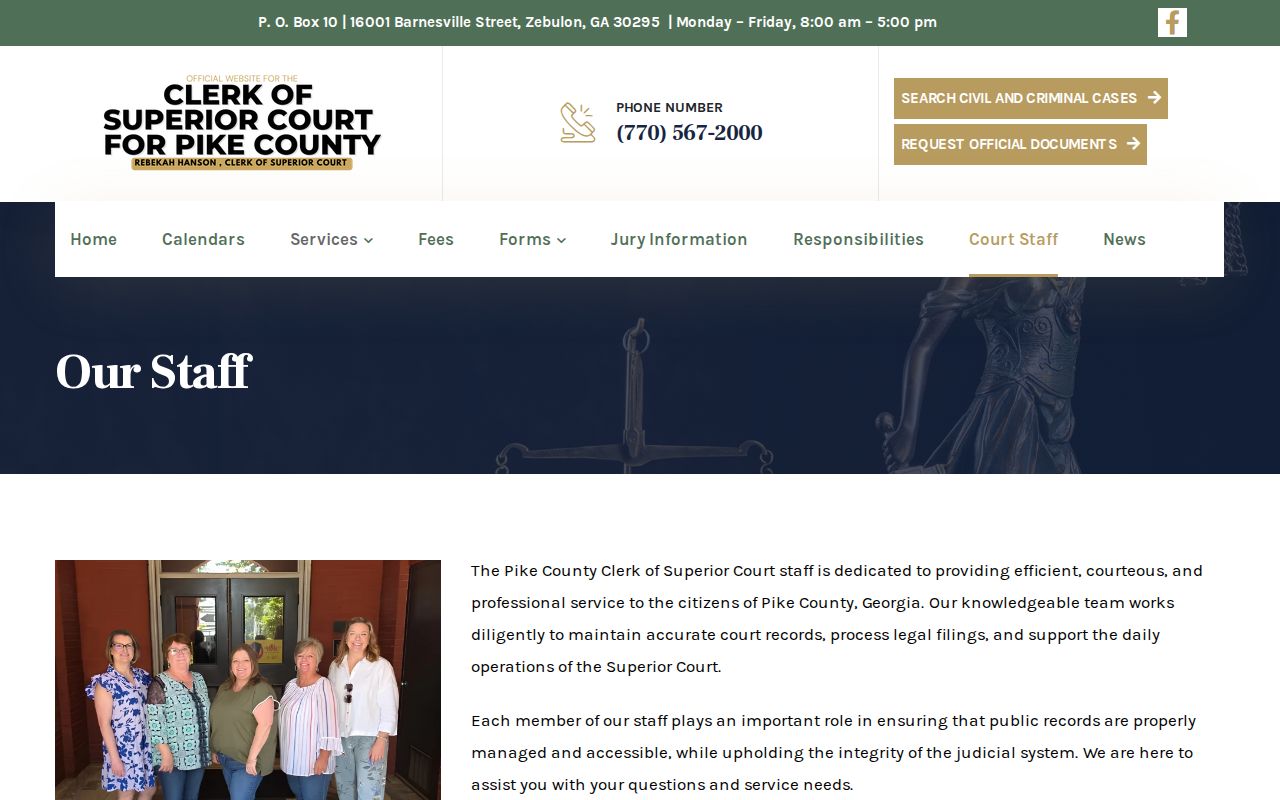
A Pike Superior criminal docket question goes fastest when it reaches criminal staff. Calling an unrelated office just burns time. Routing matters most when the public scan leaves it unclear whether a disposition or a new setting was entered, since criminal staff can pull the criminal docket entry and read it to you.
How a Criminal Case Moves
A Pike County criminal docket builds up piece by piece. The clerk records each court act. The case may open with a warrant, accusation, or indictment. From there it picks up appearance and calendar events. Later, motions, continuances, pleas, trial activity, disposition, and sentencing orders may all land in the docket. Each filing adds its own line.
Docket flow: Filing › Arraignment › Pretrial › Plea or Trial › Disposition › Sentencing
Think of this as a reading aid. It is not a promise that every Pike County criminal case hits each stage. A plea can end things without a trial. A reset adds a setting but never changes the charge. An appeal works differently. It creates later docket entries. It can send filings to the Court of Appeals of Georgia or the Supreme Court of Georgia. Read the events in date order. When the outcome matters, compare them against the actual order.
Pike Criminal Entries in Plain Terms
Labels on a Pike County criminal docket name different legal acts, so treating them as synonyms invites the wrong conclusion. These meanings track the Clerk's listed work and Georgia court sources.
- Accusation
- A charging document listed by the Pike Criminal Division.
- Indictment
- A grand-jury charging document filed in Superior Court.
- Calendar call
- A session used to call or organize matters and settings.
- Disposition
- The action resolving or closing the court matter.
- Bond forfeiture
- A process recorded when bond terms are not met.
- Grand Jury Presentment
- A filing or report within the Criminal Division's scope.
A warrant entry is a step, not a verdict. It never tells you how the case ends. To see the real result, follow the Pike County criminal docket through the later stages: the plea, the trial, the orders, and the final disposition event.
Courts That Hold Criminal Dockets
Pike County runs criminal dockets through several courts. None of them is a State Court. Felonies belong to Superior Court, along with any criminal cases filed there. Probate Court holds limited criminal jurisdiction, including county traffic matters. The Magistrate Court takes care of warrants, first appearances, and other lower-court work. Each municipal clerk keeps that city's own ordinance and traffic docket.
The Pike Magistrate helpful-links page states plainly that no State Court exists here.
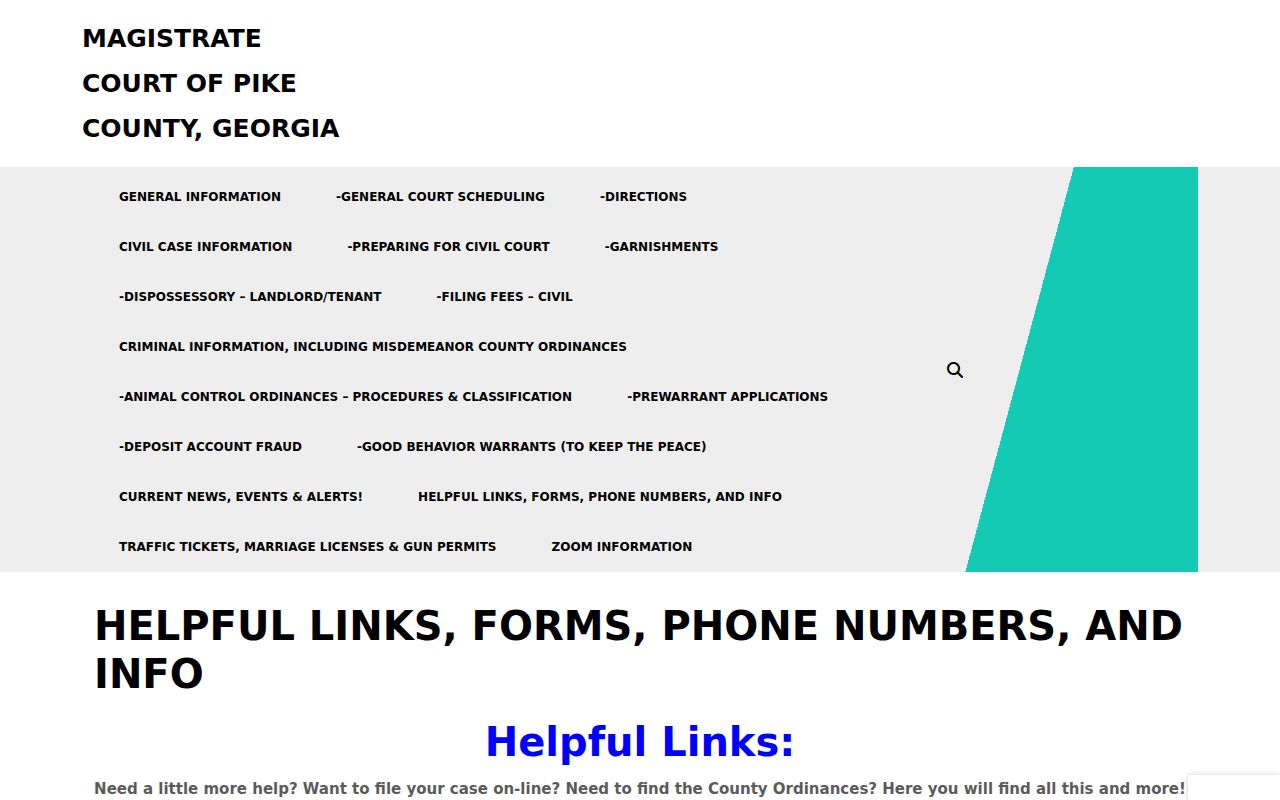
If a State Court docket search comes up empty, do not keep hunting in an office that does not exist. The case likely sits with the issuing lower court. Otherwise, try the Pike Superior Clerk.
| Court | Scope | Route |
|---|---|---|
| Superior | Felonies and cases filed there | Clerk, calendars, provider |
| Probate | Limited criminal and county traffic | Probate clerk |
| Magistrate | Warrants and lower-court work | Magistrate clerk |
| Municipal | City ordinance and traffic | City clerk |
Pike Docket Versus History Record
A Pike County criminal docket is the court record of a single case. A Georgia criminal-history or GCIC record is something else entirely. It is built from different sources and governed by different restriction rules. The Criminal Division reports dispositions. The Criminal Case Data Exchange can move data between systems. Neither one turns a docket into a complete history certificate.
The official CDX dashboard lists a 60-day update cadence. It lets you filter by county or entity. That cadence makes it useful context on data flow. It is not the place to confirm a live Pike County hearing. For settings, use the calendar and the clerk. When you need the wording of an order, ask for the filed order itself. Any access question turns on state restriction guidance plus the actual court order.
Note: A disposition can describe the result of one Pike County case. It does not prove what every state or local record holds or lacks.
Sealed Dockets and Public Access
The Pike County Clerk opens court records to inspection and copying. Three exceptions apply: juvenile records, adoption records, and anything sealed by court order. Public does not mean every page is online, however. Protected identifiers deserve restraint as well. Just because a filing exposed them once, no one should repeat them elsewhere.
Uniform Superior Court Rule 21 governs access and sealing in Georgia. A limiting order must name the affected record and state its duration, nature, and reasons. Rule 36.17 tells filers to limit sensitive identifiers in the first place. The state's restriction information adds a warning worth heeding. A restriction in the state system does not erase every local source.
Access rule: Separate the public calendar, docket entry, filed image, and certified copy. Each layer can have a different route.
Pike Certified Criminal Documents
A certified criminal document is more than a Pike County criminal docket entry. The Superior Clerk takes inquiries three ways. Visit the counter at 16001 Barnesville Street, Zebulon, Georgia 30295. Mail works too, at P.O. Box 10. Or call 770-567-2000. The clerk will quote a price for a plain copy or a certification. So ask about the precise document you need.
Georgia's GSCCCA eCertification service is another official route. Pike Superior Civil, Criminal, and Real Estate records all appear on its availability list. Accounts and authentication codes control delivery of certified documents. It is not a free bulk docket search. When ordering, supply the court, the case number, the document title, and an approximate filing date when known. Those details distinguish a sentence, disposition, order, or pleading from the short event label on a calendar. The Pike County case lookup page adds context on the provider and the clerk fallback.
Before requesting anything, decide whether you need proof of a court act or notice of a setting. A calendar only confirms that a Pike County criminal matter reached a session list. A docket entry shows that a plea, motion, disposition, or order event was recorded. A plain copy reproduces a filed page. A certified copy carries the clerk's authentication. Asking for the right product avoids a second trip. It also keeps the docket search tied to the court record that answers the question.
Mail requests should name Pike County Superior Court. Include the case number if known. Identify the document sought, and give contact details for a fee quote. A phone call helps with routing and dates. It may not replace a written request or payment, though. At the counter, ask whether the record can be inspected. Also ask whether any part is sealed or redacted. For an appeal, state whether the paper sits in the Pike Superior file or the later appellate record. Calendar, provider, counter, and eCertification each expose a different layer of the same case.